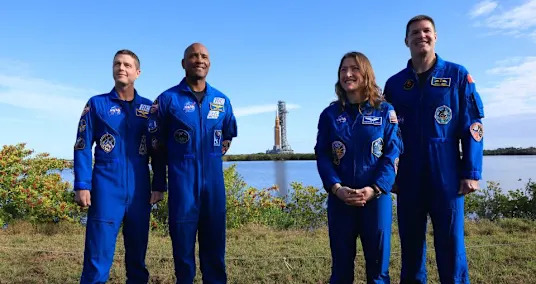
The first woman. The first person of color. The first Canadian.
The four people who will soon step aboard a spacecraft for the first human moon mission in more than half a century represent a tapestry of historic milestones. The crew of the NASA-led Artemis II mission is set to expand the roster of deep-space explorers beyond the narrow scope of the Apollo-era astronauts — a group exclusively composed of White American men, almost all with military backgrounds.
Yet while the astronauts will usher in an era of diversity for deep-space exploration, their credentials echo those of their Apollo counterparts.
The crew includes NASA’s Reid Wiseman, a Navy test pilot and single father who will serve as commander of the mission; Victor Glover, a naval test pilot who will become the first Black person to travel to deep space; Christina Koch, an engineer and record-holding astronaut who will become the first woman to venture to the moon; and the Canadian Space Agency’s Jeremy Hansen, a fighter pilot who will be the first non-NASA astronaut to join a lunar mission.
The high-stakes journey to the vicinity of the moon will take them beyond its far side — deeper into space than any human has ventured before — and it will pose myriad risks to the astronauts.
The 10-day, roughly 600,000-mile (965,600-kilometer) trip that’s set to launch as soon as April will expose the crew to dangerous levels of radiation. At various crucial points in the journey, the crew expects to lose contact with mission control because of the sheer distance and physics involved with the flight. Unexpected communications blackouts are also a real possibility.
And the astronauts will be the first humans to fly aboard the Orion spacecraft and the Space Launch System rocket — pieces of hardware NASA has spent two decades and more than $40 billion developing that still have known issues.
In interviews, the Artemis II crew members have expressed their hopes and optimism while also giving surprisingly candid nods to the realities of risk.
“It’s plausible that we can’t talk to Earth, and we’re having trouble with the spacecraft,” Hansen told the Canadian Broadcasting Corp. about his mission training.
“What are the bare basics to give us a fighting chance to still be breathing and to hit somewhere on the planet and ideally hit the Pacific Ocean? Obviously, I’ve had that conversation with my wife and my children.”
Still, the four have also spoken openly about what this mission will mean for themselves and for NASA and its international partners, the CSA and the European Space Agency, which are racing to return humans to the lunar surface amid a new space race with China.

NASA has long billed the Artemis lunar exploration program as a stepping stone for exploring deeper into the cosmos.
Artemis II is a test flight that will circumnavigate the moon and will not land on its surface, but it will serve as a pathfinder mission for Artemis III, which is expected to touch down near the moon’s largely unexplored south pole.
The Artemis program’s overarching goal is to hash out how humans can permanently live and work on the lunar surface. And that feat, according to the space agency, will help NASA discover how people can survive monthslong trips to Mars.
“We need to celebrate this moment in human history,” Glover said after his selection for the Artemis II mission in 2023. “It is the next step in the journey that will get humanity to Mars.”
Reid Wiseman

Hometown: Baltimore
Past spaceflight experience: Rode aboard a Russian Soyuz capsule to spend 165 days on the International Space Station in 2014.
Artemis II role: Commander
Taking with him: A blank notecard to jot down his thoughts.
Wiseman is a 50-year-old decorated naval aviator and test pilot who joined NASA’s astronaut corps in 2009. Most recently, Wiseman was chief of the astronaut office — a role that’s been described as thankless but advantageous because it allows holders to assign themselves to whichever mission they would like upon stepping down.
When asked why NASA is going back to the moon, Wiseman does not mince words: “Because we want to see humans on Mars,” he said in 2023 on “The Late Show With Stephen Colbert.”
Wiseman’s late wife, Carroll Taylor Wiseman, was a nurse in a newborn intensive care unit who died in 2020 following a battle with cancer.
And Wiseman has said he paid careful attention to his two daughters in preparation for his 10-day trip to the moon.
“I went on a walk with my kids. I told them, ‘Here’s where the will is, here’s where the trust documents are, and if anything happens to me — here’s what’s going to happen to you,” Wiseman said. “I actually wish more people in everyday life talked to their families in that way because you never know what the next day is going to bring.”
Victor Glover

Hometown: Pomona, California
Past spaceflight experience: Piloted the SpaceX Crew-1 mission, the first routine six-month mission to the International Space Station aboard the Crew Dragon spacecraft that launched in 2020.
Artemis II role: Pilot
Taking with him: A Bible and an heirloom for his family members.
Glover, 49, often appears the most reserved of the group, rarely showing emotion.
“Excitement, for example, is something I get asked about a lot — and I don’t let that out often,” Glover said during a January 17 news conference. “I think it can become a distraction.”
Glover has several master’s degrees, including a master of science in flight test engineering from Air University at Edwards Air Force Base in California, a master of science in systems engineering from the Naval Postgraduate School, and a master of military operational art and science from Air University in Alabama.
The test pilot world is one in which the skilled, manual handling of complex machines is highly prized, and those who parlay their test pilot experience into the world of astronautics often face questions about how they feel stepping inside a spacecraft that’s largely automated.
Legendary test pilot Chuck Yeager, for example, famously described NASA’s Mercury astronauts of the early 1960s as “Spam in a can.”
When asked about that long-running (mostly good-natured) line of questioning, Glover joked he’s “a little bit of a Luddite.”
“I love the inceptors or the controls that I can, you know, put my hands on,” Glover said, but he also embraces automation as the future, noting, “We’re not going to undo all of that.”
But what hasn’t changed are the needs and desires of humans on board these vessels — something he said he realized while reading old reports from Mercury, Gemini and Apollo astronauts.
“They say the same things that we say: that having a window is important, having the ability to do critical functions is important, and just how we implement that is going to change with the state of technology.”
Glover is married to Dionna Odom Glover, and they have four daughters. He has said he’s glad that the crew’s families will be assigned an Earth-bound astronaut to stay in close touch and comfort them during the mission.
Liftoff “can be this terrific and terrifying moment all at the same time, and so I’m just really grateful to that team that helps us to get ready,” Glover said.
Christina Koch

Hometown: Jacksonville, North Carolina
Past spaceflight experience: After launching to the International Space Station aboard a Russian Soyuz capsule in 2019, Koch spent 328 days in low-Earth orbit — a record for the most consecutive days in space for a woman. That year, she also participated in the first all-female spacewalk.
Artemis II role: Mission specialist
Taking with her: Handwritten notes from her loved ones. During the mission, “I can hold in my hands something that they held in their hands,” Koch said.
Koch — whose surname is pronounced “cook” — has a master’s degree in electrical engineering from North Carolina State University. She previously worked on Earth observation satellites at NASA’s Goddard Space Flight Center in Greenbelt, Maryland, and served stints at some of the most remote laboratories on the planet, including the Amundsen-Scott South Pole Station and Palmer Station in Antarctica.
“I loved things that made me feel small, things that made me ponder the size of the universe, my place in it,” Koch said in a 2020 NASA video
She joined the astronaut corps in 2013.
Koch said she has long admired the Apollo astronauts, who seemed to enjoy reuniting at NASA events, even decades after retiring from the corps.
“What they went through together and how that bonded them has been really instrumental for me in appreciating every single day with my crew,” Koch said in a January 17 news conference.
She said she would never forget being at an event and seeing Apollo 13 astronaut Fred Haise, who bluntly said, “I heard you’re going to break our record” for the farthest humans have ever traveled into space. The Apollo 13 crew reached 248,655 miles (400,171 kilometers) from Earth in 1970, but Artemis II could break that record, expecting to travel more than 250,000 miles (about 402,000 kilometers).
“At that moment,” Koch said of Haise, “he brought me into that camaraderie.”
And while Koch said she’s excited and prepared to shatter more records with her Artemis crewmates, she has grappled with the practicalities of leaving her husband at home with no easy way of communicating with her during the mission.
“I really have to make sure he knows that it’s not like the International Space Station where we can just make a phone call — so he’s not going to be able to call me and ask where something is in the house,” Koch joked. “He’s going to have to find it.”
Jeremy Hansen

Hometown: London, Ontario
Past spaceflight experience: None
Artemis II role: Mission specialist
Taking with him: Four moon pendants he gave as gifts to his wife and children.
The Artemis II mission will mark the first trip to space for Hansen — a stunning feat as most first-time fliers stick closely to home on missions to low-Earth orbit, where the International Space Station lies. On Artemis II, Hansen will travel roughly 1,000 times farther.
Hansen grew up on a farm, and he said he used to plow the living room carpet with toy tractors and pretend his treehouse was a rocket ship — but he also dreamed about flying airplanes, jets and spacecraft before becoming a Royal Canadian Air Force fighter pilot.
While he does not have previous astronaut experience, Hansen does bear the titles of cavenaut and aquanaut.
His spelunking training came from the European Space Agency’s CAVES program, in which he explored underground for six days on the Italian island of Sardinia to prepare for living and working with others in remote, isolating conditions.
And Hansen was a member of the NASA Extreme Environment Mission Operations, or NEEMO 19, excursion, spending a week in an underwater habitat near Key Largo, Florida.
“It’s actually very dangerous,” Hansen told the CBC of his aquanaut training, noting that any attempt to return quickly to the surface could be lethal because of the bends or decompression sickness.
“We’re down there for a week. We’re completely saturated,” Hansen recalled. “So, if you have a problem down there and you just decide to go to the surface, you’re dead.”
When a reporter asked his American colleagues what the neophyte astronaut could bring to the table, Hansen, who is considered the comedian of the group, quipped, “Well, you only get one question.”
“He’s the funny one,” Glover confirmed between chuckles.
Hansen is also uncommonly tall for an astronaut — 6 feet, 2 inches (nearly 2 meters). During a Sepetember news conference, Wiseman joked that their 16.5-foot-wide (5-meter) Orion spacecraft will feel large enough for most of their 10-day trip — “until Jeremy starts exercising,” Wiseman said. “Then it’s going to feel small again.”
When asked about the dangers involved in his landmark mission to deep space, Hansen said the Artemis II crew is “taking calculated risks.”
“We’re going to take some appropriate risks, and we’re going to accomplish some extraordinary things,” he noted. “We’re going to have some failures, some setbacks along the way, and then we’re going to pick ourselves back up and keep going.”
NASA’s Artemis program is sending humans into deep space for the first time in more than five decades. Sign up for Countdown newsletter and get updates from CNN Science on out-of-this-world expeditions as they unfold.
For more CNN news and newsletters create an account at CNN.com
latest_posts



 How HIV/AIDS got its name − the words Americans used for the crisis were steeped in science, stigma and religious language
- Jason Kelce opens about wife Kylie Kelce's past pregnancy loss
- The most effective method to Distinguish the Best Material Organization in Your Space
- US FDA panel to weigh bid to market nicotine pouches as lower-risk than cigarettes
- The Significance of Prenuptial Arrangements in Separation Procedures
- Find the Standards of Viable Nurturing: Supporting Blissful and Strong Kids
- RFK Jr.'s diet guidelines emphasize red meat, full-fat dairy. How healthy are they?
- An Aide On Upgrading Your FICO rating
- Carry Nature Inside with These Staggering Plant Decisions


