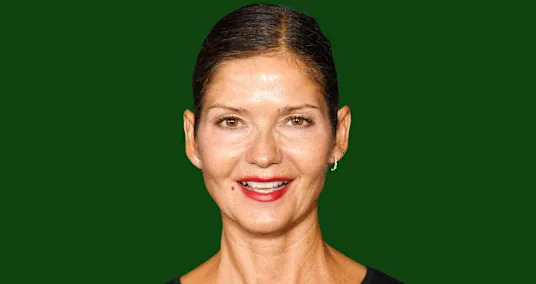
For more than 30 years, Jill Hennessy has been a familiar presence on TV, evolving with every era — from Law & Order and Crossing Jordan to Madam Secretary and now Hope Valley: 1874, a prequel to Hallmark+’s When Calls the Heart, which centers on women quietly supporting one another.
She dons petticoats to play Hattie Quinn, a sage and resourceful trading post owner who’s a grounding force in a frontier town — and part of a rare onscreen sisterhood with costar Bethany Joy Lenz that isn’t fueled by rivalry.
“One thing I really appreciate today is the support, love and connections I have with other women — it’s so genuine and energizing,” Hennessy, 57, tells me for Yahoo’s Unapologetically series. “So it’s nice to see that reflected in a TV show as a through-line.”
Offscreen, Hennessy has spent years plowing her own path as a singer–songwriter, releasing music independently and sharing it on her own terms through social media. The 17-year-old version of herself — the one who moved from Canada to New York City with two duffel bags, a guitar and a dream — would recognize that same instinct to take risks.
“I'm giving myself that allowance and freedom to say, ‘Well, why don't I just try this?’ and putting myself out there even more,” she says. “I'm enjoying this newer me. I feel a little broader in my interests, a little more courageous when it comes to taking chances.”
Here, Hennessy talks about leaning into her gutsiness, what it’s like to have people still discovering her ’90s work and why she won’t watch Love Story.

What was it about Hope Valley: 1874 and Hattie that felt like a meaningful story to put out in the world?
What drew me to the script is how independent and resilient the female characters are — especially mine. She comes to the frontier in hope and prayer with her husband and young child, then loses her husband. She wasn’t planning on doing this herself, but she is.
When she meets Bethany Joy Lenz’s character, who has also lost her husband and arrives with her young daughter, Hattie realizes how much she’s been craving a deep, genuine connection with another woman. The writing around their relationship is heartfelt without being saccharine, and that bond becomes the backbone of the show, which is something you rarely see. There's no stereotypical competition.
So many people know you from playing prosecutor Claire Kincaid on Law & Order and still rewatch those old episodes. What is it like to have that ’90s version of yourself so present today?
It’s kind of exciting. I’m 30, 35 years older than I was when I did that show. What shocks me is that people still recognize me from it. I feel like kissing them and thanking them and saying, “I can’t believe you recognize me — that was so long ago!”
It also allows me to appreciate who I was then, because I’m much more comfortable in my own skin now. Back then, I was new to the country, 24 years old and working a bit in a vacuum. There was no real feedback. We weren’t in front of a live audience. There was no social media. So it feeds my soul now. It’s like getting applause years after the performance — and I’ll take that any day.

When you watch your early work, can you focus on your performance, or do you think more about what was going on in your life at that time?
What was happening in my life, but also little flashes from set. I’ll watch an interrogation scene with S. Epatha Merkerson and remember we were laughing about something Jerry Orbach said. The scene is very serious, but all I can think about is how Epatha and I were trying not to laugh.

You memorably played Jackie Kennedy in the movie Jackie, Ethel, Joan: The Women of Camelot. Did you watch Love Story?
I haven’t seen Love Story yet. It makes me a little nervous. When I played Jackie, it was so daunting because I love her so much. My twin sister was named Jacqueline, partly for Jacqueline Kennedy, so I’ve always felt a connection to her.
Playing her opened the door to meeting people who knew her — I did a lot of research — and insights like that gave me a beautiful inner look at her life. Because of that, I get nervous about watching things like Love Story. I would hate to see anything that might have hurt her.
It’s made everyone obsessed with all things ’90s right now, especially ‘90s New York. I was thinking how that coincides with your Law & Order years. What were the ’90s like for you?
The ’90s in New York were incredibly exciting for me because I was coming in as this total outsider from Canada. I arrived with two duffel bags to appear in the Broadway musical The Buddy Holly Story, playing his wife. I didn’t know if the move would be permanent, but I wanted it to be.
Then, to get a show like Law & Order. At that point, it wasn't well-known. I came in the fourth season, and it was about to be canceled. Dick Wolf was being pressured to add women to the cast, so they decided to add two female characters, Epatha and myself, and within that year, the ratings went up — and it just got more and more successful.
What are you enjoying most about being in your 50s?
I’m really enjoying this sense of being very free. Also, appreciating all the hard work that got me here — my career, my music, my family, particularly my kids. What amazing, beautiful people these two guys are — they’re 18 and 22 — and how lucky I am to be with them. I love seeing where they’re going with their pursuits, but I also just like to sit on a couch with them and watch anime. They got me into anime, and now I'm so addicted. I can talk to any 16-year-old on the street about Jujutsu Kaisen.
As you nudge toward 30 years of marriage to Paolo Mastropietro, what’s one piece of relationship advice that’s actually held up for you?
Always communicate. Be honest about the good and the bad: “This is working,” or “This isn’t working.” I realize it can feel terrifying to say things that might be upsetting, but you really need to, and your partner might be feeling the same thing. And then, just as important, always find the fun or the silly. Silly is underrated, and it’s necessary for day-to-day survival.

How do you take care of your body, mind and soul?
I’m addicted to running. It just makes me feel better. It's mainly for my head too — it's the best stress reliever I've ever come across. Yoga too. I happened upon a great yoga community here in New York City about 18 years ago, and I still go for the community and the psychological therapy, because I love these people.
What’s your relationship like with social media?
One thing it’s has done for me is really help my music. I don’t have a label, it’s just me, and it’s nice to have that control: I’ve got a song; I can post it. It will be copyrighted. I can get it to my fans — or let them know if I’m doing a surprise concert in Washington Square Park. But in other ways, I do see how [social media] is detrimental to one’s self‑image. The constant comparison, the filters and trying to aspire to some artificial look or idea of success. It makes the illusion look very credible and real, which can be very detrimental.
There’s a growing trend of celebrities being more open about cosmetic procedures and everything that goes into looking good on camera or the red carpet. Do you think it’s liberating that people are talking about it, or does it create more pressure?
There's so much pressure, whether you're a performer or you have a job that doesn't require you to be in front of a camera. Social media puts so much pressure on everybody of every age group. What I found scary was how many young people —very young — feel pressured to get procedures done. I want to scream: “You're so beautiful!” But it's a personal choice. That's one of the reasons it’s freeing that people are talking about it — it leaves the choice up to you, whether you want to investigate that, talk about it or not participate at all. But what I think is unhelpful is the judgment toward people who do choose to go down that path — or don't. That always disappoints me when I see the criticism.
Who are the women you look to as examples of aging with power and purpose?
I tend to look to musicians. I’ve always loved Emmylou Harris, who’s so ever-present and has never stopped. Bonnie Raitt, Susan Tedeschi, Lucinda Williams, Tracy Chapman — there are just so many incredible female performers out there who just blow my mind and are just getting better and better.
This interview has been edited for length and clarity.
latest_posts
- 1
 6 Savvy Locks for Lofts
 - 2Nearly half of reindeer have been wiped out and armadillos are in Iowa. Here’s how animals are weathering warming holidays
- 3Moving Wedding Objections for Paramount Functions
- 4German official report: Teen social media ban faces legal hurdles
- 5Home Remodel Administrations: Change Your Residing Space



- BioMarin to acquire Amicus Therapeutics for $4.8 billion in rare disease bet
- Merz: 80% of Syrians in Germany should return in three years
- 6 Natural products High In Vitamins,Which One Do You Like to Eat
- Don't miss Jupiter shining close to the waning gibbous moon on Dec. 7
- Instructions to Decide whether a Fender bender Legal counselor is Required for Your Particular Case
- An Investigate of 6 Creative Specialty Mixed drinks
- Horses really can smell our fear, new study finds
- The next frontier in space is closer than you think – welcome to the world of very low Earth orbit satellites
- Dependable Savvy Locks to Update Your Home Security