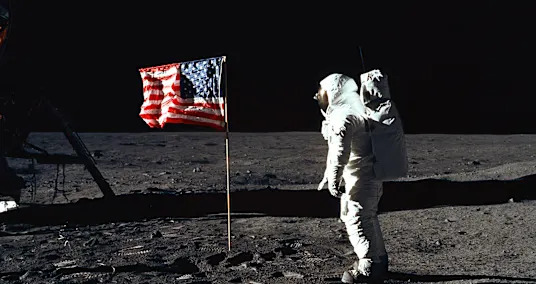
On Sept. 12 1962, President John F. Kennedy famously declared that the United States would “go to the moon … and do it first, before this decade is out.”
“We choose to go to the moon in this decade and do the other things,” Kennedy said, “not because they are easy but because they are hard.”
Then America followed through. Less than seven years later, on July 20, 1969, Neil Armstrong and Buzz Aldrin descended from their lander and left humankind’s first lunar footprints.
Today that pace of progress might seem impossible. On April 1, NASA is scheduled to launch Artemis II — America’s first crewed lunar spaceflight in more than a half century. Its mission is clear-cut: Send four astronauts around the moon and back in 10 days.
But Artemis II’s mission is also … familiar. In 1968, three Apollo 8 astronauts circled the moon without landing, then traveled back to Earth.
In other words, NASA already pulled off a version of Artemis II nearly 60 years ago — and did so without the long delays that have plagued Artemis II itself (which was previously scheduled to lift off, and then delayed, almost every year since 2021).
How can going to the moon be so difficult if we already did it? Here are five reasons human space flight is such a big challenge today.
Rustiness
The last time humans set foot on the moon was in 1972, with Apollo 17. That was also the last crewed mission beyond low Earth orbit — period. Even uncrewed lunar landers fell out of favor soon after, with more than 35 years elapsing between one successful robotic landing on the moon’s surface (the Soviet Union’s Luna 24 in 1976) and the next (China’s Chang’e 3 in 2013).
“There were decades when people were not developing landers,” one expert told the Guardian in 2024. “The technology is not that common that you can easily learn from others.”
Turns out that it’s hard to resume human space exploration after a multi-decade hiatus — especially when complex new technologies need to be integrated with older ones.
“We stopped, and then we forgot,” Scott Pace, director of the Space Policy Institute at George Washington University, recently told Scientific American. Just because you ran an Olympic marathon 50 years ago, Pace went on to explain, doesn’t mean you could do it again tomorrow.

Ambition
Despite some superficial similarities, the Artemis program isn’t really Apollo, part two. Apollo sought to put people (briefly) on the moon. Artemis aspires to establish a permanent base there — a base that astronauts can later use as a stepping stone to Mars.
That’s a much more ambitious goal, and it defines every facet of Artemis: the Space Launch System (SLS) rocket that propels the astronauts beyond Earth’s atmosphere; the Orion spacecraft in which the four of them can spend 21 days; separate next-generation space suits for launch and entry as well surface exploration; robotic landers carried on commercial rockets that deliver equipment to the moon itself; and finally, the reusable rocket-and-human-lander system — either SpaceX’s Starship or Blue Origin's Blue Moon — that will eventually orbit the moon and dock with Orion before transporting the Artemis crew to and from the surface.
In short, there are more moving parts now than there were in the 1960s, which means more potential delays.
Motivation
In the 1960s, the U.S. was competing with the Soviet Union in an existential space race. Cold War conventional wisdom decreed that whichever superpower arrived on the moon first would reinforce its military dominance — and project precisely the kind of soft power that could sway newly independent countries to choose democracy over communism.
There’s a certain clarity about one-on-one competition, and the U.S. immediately mobilized around beating the Soviets to the moon. Now that clarity is gone. In its place is a more nebulous (and less pressing) objective: international cooperation in the name of scientific discovery. Japan, Canada, the United Arab Emirates and the European Space Agency are all collaborating with the United States on Artemis.
As a result, one president’s spaceflight plans are often canceled by the next, only to be resurrected later in a different form, and delays accrue while countries do the important work of getting on the same page about the future of space and contributing hardware to the cause.
Money
Between 2012 and 2025, the U.S. spent roughly $93 billion on the Artemis program. Total spending is expected to top $105 billion by 2028, the year the first Artemis astronauts are supposed to land on the moon.
That’s no small sum. But Apollo cost more than three times as much: about $320 billion in today’s dollars, according to the Planetary Society. Likewise, about 4% of the federal budget went to NASA in the Apollo era. Today the space agency is lucky to get 1%.
Experts say that shift is sensible. “There’s no reason to spend money like it was a war,” John Logsdon, professor emeritus at George Washington University and founder of the Space Policy Institute, told Scientific American. “There’s really no national interest or political interest that provides the foundation for that kind of mobilization at this point.”
But sensible or not, less funding almost always means slower progress.

Safety
Given the scientific, cooperative nature of today’s moon missions — not to mention all the advances in computer modeling since the 1960s — it would be irresponsible for NASA not to consider every possible safety consequence of Artemis — to the astronauts themselves and to the broader environment.
This wasn’t quite the case during the Apollo era. Back then, swashbuckling fighter pilots were converted to astronauts and rocketed into space much in the way they’d previously been deployed to war: with the knowledge that they were doing something very, very dangerous. The risk was worth the reward (i.e., winning the space race).
But today engineers can run detailed simulations on Orion’s materials and the stresses the capsule will be under, including high temperatures and intense acceleration forces — and that’s exactly what they’ve been doing for years.
Even then, Artemis I — an uncrewed moon-orbiting mission launched in 2022 — showed that Orion’s heat shield broke down differently than predicted; that bolts on the spacecraft faced “unexpected melting and erosion”; and that the power system experienced anomalies that could endanger the future crew.
It took time for NASA to resolve these issues — just as it will take time to address any issues with, say, Orion’s life support systems that arise during its first crewed mission. Building earthbound infrastructure is slower and more expensive today than it was in the 1960s; so too is exploring the cosmos.
Some would argue that the tradeoff is worth it. “For Artemis, having a more robust rocket system, asking people what they think, keeping people safer and working with global partners are probably better for this world — even if they don’t result in expedience off-world,” Scientific American concluded in its recent story on the subject.
Put another way: At least NASA is still doing hard things, even if they’ve gotten (a lot) harder.
latest_posts
- 1
 'An incredible privilege and responsibility': Artemis 2's Christina Koch is ready to become the 1st woman to fly around the moon
 - 2The World's Dazzling Regular Miracles
- 3Minnesota jury says Johnson & Johnson owes $65.5 million to woman with cancer who used talcum powder
- 4Step by step instructions to Appropriately Keep up with Your Sunlight powered chargers for Most extreme Productivity
- 5Intriguing Strange Cruising Objections you Should Visit


- The most effective method to Consummate the Specialty of Handshaking in Business and Group environments
- New hybrid mpox strain discovered in UK after US reports local spread
- Top 10 Arising Advances That Will Shape What's in store
- ‘It’s Israeli policy’: Report reveals abuse of Palestinians in prisons
- 'Wuthering Heights' trailer features Margot Robbie and Jacob Elordi in a steamy forbidden romance
- Earth’s magnetic field protects life on Earth from radiation, but it can move, and the magnetic poles can even flip
- A soft launch, an unfollow and a lot of questions: Breaking down the 'Summer House' romance blowing up group chats
- The most effective method to Really Adjust Hypothesis and Practice in Your Brain science Studies
- Travels to Dream Objections in Europe